
Lo admito el primero: los qubits son difíciles de entender. Todos necesitamos visualizaciones útiles para hacer entrar en la cabeza las cosas complicadas.
La representación de Bloch es una correspondencia sencilla entre estados de qubit y puntos en una esfera.
Try moving the sliders to see how the Bloch sphere changes!
La esfera de Bloch aporta dos ideas clave de intuición.
Intuición n.º 1
Si mides el qubit, la probabilidad de obtener un resultado depende de cuánto se alinea la flecha con la dirección de ese resultado. Por ejemplo, un punto en el polo superior tiene un 100 % de probabilidades de medirse como |0⟩; un punto en el ecuador da probabilidades 50/50.
En el polo superior
100 % de probabilidades de medir |0⟩
En el ecuador
Probabilidades 50-50 de medir |0⟩ o |1⟩
(pero 100 % de probabilidades de medir |+⟩)
No hace falta que lo sepas, pero la regla exacta es P = cos²(α/2), donde α es el ángulo entre la flecha y la dirección del resultado. Se conoce como la regla de Born.
Intuición n.º 2
La misma regla de alineamiento vale para cualquier dirección de medida, no solo arriba-abajo. Cada eje que atraviesa la esfera define un par de resultados de medida en sus dos polos. Mide a lo largo del eje x y los resultados son |+⟩ y |−⟩. Mide a lo largo del eje y y son |+i⟩ y |−i⟩.
¿Cómo calculamos la representación de Bloch?
Sabemos que podemos escribir el estado de un qubit así:
α y β son números complejos, con |α|² + |β|² = 1
A partir de esas dos amplitudes complejas, podemos calcular θ y φ:
Para pasar de los ángulos de Bloch a un vector de estado:
θ ∈ [0, π] te inclina entre |0⟩ arriba y |1⟩ abajo. φ ∈ [0, 2π) te hace girar alrededor del ecuador.
Puertas y medidas
Cuando ves los qubits con la esfera de Bloch, gran parte de las matemáticas de la computación cuántica se vuelve intuitiva.
Las puertas de un solo qubit son simplemente rotaciones. Cada puerta de un qubit es una rotación 3D rígida de la esfera alrededor de algún eje, en algún ángulo. Elige una puerta abajo y mira cómo el vector de estado dibuja un arco hasta su nueva dirección.
Click a gate to watch the state vector rotate.
Las medidas colapsan la esfera hacia el par de puntos antípodas a lo largo del cual mides. Mide en z y el estado salta a |0⟩ o |1⟩. En x, salta a |+⟩ o |−⟩. La probabilidad de cada resultado viene dada por cuánto se inclina ya la flecha del estado actual hacia ese polo.
Pick an axis. The state collapses to one of the two opposite poles along it, with probability set by where the vector currently points.
¿Existen esferas de Bloch en la vida real?
Sí. Para algunos tipos de qubits, la esfera de Bloch no es una metáfora.
El ejemplo más claro es un qubit de espín electrónico. Los electrones son imanes diminutos: tienen un momento magnético que apunta en alguna dirección del espacio 3D. Esa dirección es el vector de Bloch. Polo norte de la esfera de Bloch = espín apuntando hacia arriba en el laboratorio. Polo sur = espín apuntando hacia abajo. Cualquier otro punto de la esfera = espín apuntando a otra parte.
Algunos puristas señalarían que, aunque resulta útil pensar en el espín del electrón como si apuntara en una dirección, solo se puede medir el espín como “arriba” o “abajo” a lo largo del eje que elijas. Así que, en sentido estricto, el espín no “apunta” a ningún sitio hasta que lo mides.
Cuando los físicos escriben el estado de un electrón así, suelen ir y venir: convertir la dirección del laboratorio a (θ, φ), sacar el vector de estado de la fórmula, hacer algo de álgebra y luego volver a convertir.
¿Qué es la fase relativa?
Fase relativa es el nombre que se le da a la diferencia entre las fases de α y β, cuando escribimos el vector de estado así:
La fase relativa es φ = φβ − φα.
Es difícil hacerse una idea de lo que la fase relativa hace en realidad, hasta que miras cómo se inventó el formalismo del vector de estado en primer lugar.
La forma habitual de escribir un estado cuántico, |ψ⟩ = α|0⟩ + β|1⟩, la inventó John von Neumann, a quien a menudo se llama una de las mentes más brillantes del siglo XX. Pero incluso el propio von Neumann llegó a dudar de que esa fuera la forma correcta de describir la mecánica cuántica. En 1935 le escribió al matemático Garrett Birkhoff:
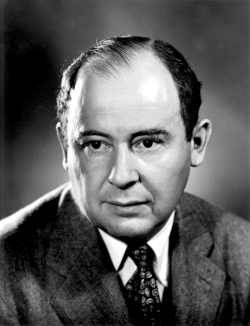
“Me gustaría hacer una confesión que puede parecer inmoral: ya no creo absolutamente en el espacio de Hilbert.”
La esfera de Bloch es más intuitiva: se corresponde directamente con cómo se comportan los qubits en realidad. Así que la fase relativa en un vector de estado se entiende mejor como la forma que tiene el formalismo de transportar el resto de la información de la esfera de Bloch.
Si solo guardáramos α y β como números reales, solo nos darían las probabilidades en la base |0⟩/|1⟩. Pero podemos medir en cualquier base (incluidas |+⟩/|−⟩ y |+i⟩/|−i⟩), y para predecir esos resultados también necesitamos saber φ.
La fase relativa en un vector de estado es solo una forma de guardar el resto de la información 3D de la esfera de Bloch. Está embebida en el vector de estado de una manera que se extiende fácilmente a más de un qubit, a lo que llegaremos en la siguiente parte.
Si la esfera de Bloch es tan intuitiva, ¿por qué usar vectores de estado?
Aunque los vectores de estado son menos intuitivos, nos permiten manejar varios qubits con facilidad. Hay reglas sencillas para combinarlos, manipularlos, etc. Además resultan encajar muy bien en un computador.
Me viene a la mente una frase del matemático Michael Atiyah sobre el intercambio entre geometría y álgebra:
“El álgebra es la oferta que el diablo le hace al matemático. El diablo dice: te daré esta máquina poderosa, que responderá a cualquier pregunta que le hagas. Lo único que tienes que hacer es darme tu alma: renuncia a la geometría y tendrás esta máquina maravillosa.”
Con los vectores de estado pasa lo mismo. Renuncias a tu intuición visual y obtienes una forma de seguir el entrelazamiento solo con números. De momento, hacemos felices ese intercambio para dos qubits en adelante. Para un solo qubit, la esfera de Bloch sobra.
Para más sobre visualizaciones multiqubit, lee nuestro whitepaper sobre la visualización de estados multiqubit.
Nota al margen: grados de libertad
¿Por qué un estado de un solo qubit, que se describe con cuatro números reales, se reduce limpiamente a solo dos ángulos en una esfera?
Empieza con 4 números reales. α tiene dos números reales y β también tiene dos.
Menos normalización, quedan 3. Como |α|² + |β|² = 1, esto elimina un grado de libertad.
Menos la fase global, quedan 2. Como ya debes saber, multiplicar un vector de estado por cualquier fase global no afecta a nada. Por tanto, eliminamos un grado de libertad más.
Y ya está. Dos grados reales de libertad, y son exactamente θ y φ en la esfera.
¿Cómo funciona una esfera de Bloch modelo?
Qubi es un modelo interactivo y de mano de un qubit. Cuando el qubit no está entrelazado con otros qubits, ¡te muestra su representación en la esfera de Bloch con una lucecita blanca!
Es una forma estupenda de construir intuición fuerte sobre el tema de esta guía, y mucho más.
Preguntas frecuentes sobre la esfera de Bloch
¿La esfera de Bloch es una esfera física real?+
No. La esfera de Bloch es una visualización matemática del estado de un solo qubit, no un objeto físico. Cada estado puro de un qubit se corresponde exactamente con un punto en la superficie de la esfera unidad. Algunas tecnologías cuánticas (como Qubi) construyen un modelo tangible, pero el objeto subyacente vive en las matemáticas.
¿Qué representa un punto de la esfera de Bloch?+
Una dirección. La flecha desde el centro de la esfera hasta un punto de la superficie te dice todo lo medible sobre un estado puro de un solo qubit: la probabilidad de cada resultado de medida, en cada base. El polo norte es |0⟩, el polo sur es |1⟩, y los puntos del ecuador son superposiciones de peso igual con distintas fases relativas.
¿Cómo calculas el vector de Bloch a partir de un estado?+
Escribe el estado como |ψ⟩ = cos(θ/2)|0⟩ + eiφ sin(θ/2)|1⟩. Entonces el vector de Bloch es (sin θ cos φ, sin θ sin φ, cos θ). θ es el ángulo polar desde el eje z y φ es el ángulo azimutal desde el eje x. De forma equivalente, las componentes del vector de Bloch son los valores esperados de los tres operadores de Pauli, ⟨X⟩, ⟨Y⟩, ⟨Z⟩.
¿Por qué se llama esfera de Bloch?+
Lleva el nombre de Felix Bloch, físico suizo-estadounidense que introdujo la representación en 1946 en el contexto de la resonancia magnética nuclear. La misma geometría la usó de forma independiente Henri Poincaré para la polarización de la luz, por lo que a veces se llama esfera de Bloch-Poincaré.
¿La esfera de Bloch solo sirve para un qubit?+
Sí: la imagen de la superficie es exacta solo para un único qubit. Dos qubits viven en un espacio de estados de 6 dimensiones que no se puede dibujar de forma tan limpia. Existen generalizaciones útiles (por ejemplo, proyectar un qubit cada vez), pero ninguna imagen para dos qubits conserva toda la misma intuición.
¿La esfera de Bloch es solo para estados puros?+
La superficie representa estados puros. Los estados mezcla, mezclas estadísticas de estados puros, viven en el interior de la esfera. La bola sólida entera es la bola de Bloch; el estado máximamente mezclado se sitúa justo en el centro.
¿Quieres jugar con una? Abre el visualizador interactivo de la esfera de Bloch.