
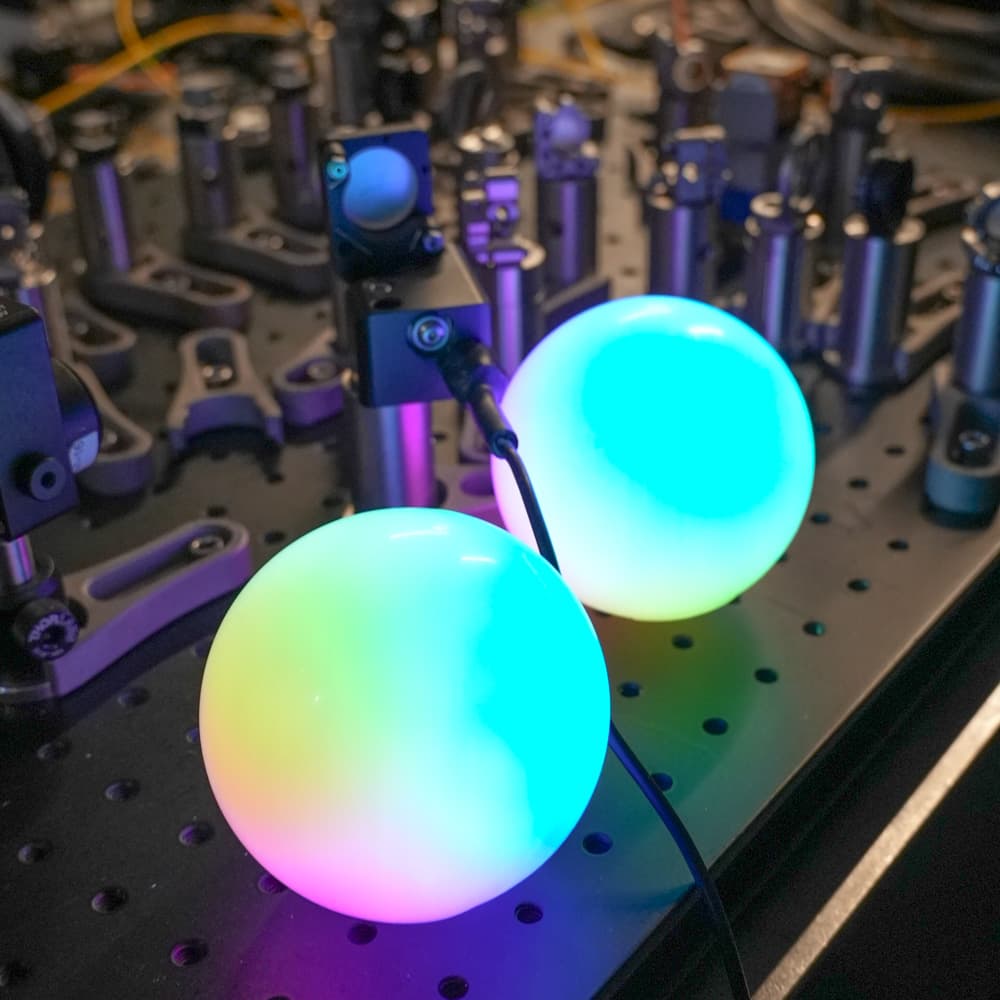
A quantum computer is a new kind of computer. Regular computers store memory in bits: 0s and 1s. Quantum computers store memory in qubits: ups, downs, sideways, and every direction in between (full guide here). This is a brand-new language for computing, and it turns out to be much more powerful for some tasks.
So what exactly can quantum computers do? We're finding new applications every month. The top three by impact today are:
- 1
Chemistry
The computational chemical factory
Design new molecules in minutes instead of millennia.
- 2
Security
The global decrypter
Every secure protocol on the internet is at risk.
- 3
Optimization
The live business optimizer
Solve the impossible scheduling problems.
The computational chemical factory
If we asked AI to invent a new space-age alloy that's lighter than air, stronger than steel, and hot pink, it might come back with a chemical formula in twenty seconds.
Verifying that it's correct, however, is the problem. On classical computers, material property verification is an exponential problem, meaning it can take years even for mid-sized molecules. It's so hard that the largest molecule ever solved exactly is benzene (C6H6), which isn't even a very large molecule. Every atom you add increases the complexity exponentially.
Why it's so hard
To determine the properties of a molecule, you need its electronic structure: how the electrons are distributed around the atoms.
Take a concrete example: blue OLEDs. OLED molecules are what light up the individual pixels in your phone screen. Pass an electric current through them, and they emit light at a specific wavelength.
The blue ones are famously inefficient. They wear out faster than the red and green, which is why phone screens dim and shift color over time. So if a chemist proposes a new molecule that emits clean blue light, we want to verify it before committing to manufacturing.
To predict the color of light the molecule emits, or its efficiency, you have to predict every possible configuration of its electrons and how likely each one is.
Examples of electron configurations are shown below. Each “blob” is a region where electrons are likely to be found.
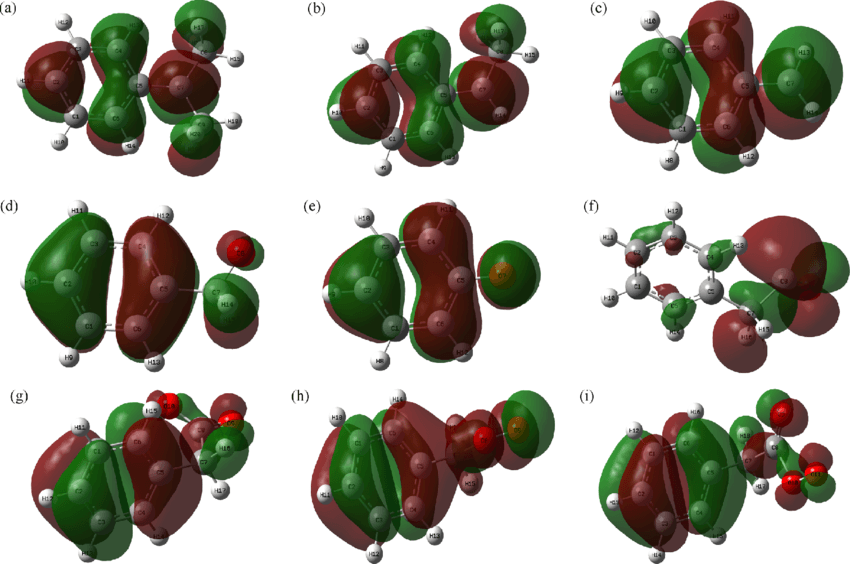
Why is this slow? Electrons fit together like puzzle pieces. They repel each other, so when one moves closer to a nucleus, another has to move farther away. Finding the most stable configuration means testing a staggering number of arrangements and checking which ones don't cram electrons too close to each other.
Physicists have been chipping away at this for decades. Several Nobel Prizes have been awarded for incremental speed-ups. Yet no algorithm can solve it for molecules with more than ~20 atoms when even one heavy element is involved (heavier elements like lead have more electrons, so the search space explodes).
What if we could?
If this weren't so slow, we could build a computational chemical factory: test billions of candidate molecules a day, and find the best ones.
🔋
Decade-long batteries
🛣️
Highways that never crack
☀️
Sunscreen without the cancer risk
This is the world I want to live in. Unfortunately, on classical computers, it can't happen. Those calculations genuinely take too long.
Quantum computers can test electron configurations exponentially faster than regular computers. They will enable the computational chemical factory. This is a trillion-dollar opportunity.
The global decrypter
The internet is secure because we encrypt the traffic between devices. A huge fraction of that encryption rests on a protocol called RSA.
Every encryption algorithm depends on some assumptions. Most of RSA's assumptions are fine. Except one:
The assumption
Factoring a 2048-bit number into its two prime factors takes ~1015 years (a quadrillion years) on the best classical algorithm running on the fastest supercomputer humanity has built. That's about 70,000× the age of the universe.
It turns out quantum computers can factor those numbers easily. So quantum computers can decrypt internet traffic.
They can break more than that. When you download software, your computer checks that it was signed by a known developer like Microsoft, Adobe, or Apple. That signature check also relies on factoring being infeasible. Anyone with a sufficiently large quantum computer can sign software pretending to be Microsoft, and your machine will trust it. Same threat for code-signing, banking certificates, VPN keys, SSH access, and most of the cryptographic guarantees you don't think about every day.
This is a real and active world-security concern. Many companies are migrating to post-quantum cryptography: algorithms designed to resist quantum attacks. Some are moving fast. Most aren't moving fast enough.
The live business optimizer(potentially)
Businesses are extremely inefficient. The advanced ones use optimization algorithms to allocate resources better. Some examples:
- Investment firms use portfolio optimization to decide where to put money.
- Hardware companies turn their supply chains into optimization problems.
- Transportation companies solve routing and scheduling problems to keep customers happy (and, more often, save money).
Most of these optimizations take days, sometimes years. You can't do them live. In fact, most businesses don't even wait for them to finish. They cut them off after a set time and ship whatever the best answer was at that point. That leaves money on the table.
The honest caveat
Quantum computers might be able to do optimization significantly faster. But there are no guarantees. That's the problem with this field: it's almost impossible to prove an optimization method is better before you actually try it on hardware. Most researchers believe we have to wait for bigger quantum computers to see if this pans out.