
“Anyone who is not shocked by quantum theory has not understood it.”
Quantum physics is what I call an “existential science.” It's a science that puts us in direct contact with the strangeness and grandeur of the universe.
It is also a “useful science.” It promises technology that will create billion-or-trillion dollar industries.
But of course, it is a misunderstood science. Less than a hundredth of a percent of humans can explain what quantum actually is or where it's going. The goal of this course is to make you one of the ones that can.
What “quantum” means
Quantum means “in parts.” When scientists started working with tiny things like electrons and photons, they witnessed unintuitive behaviors, which they called “quantum” behaviors. These behaviors did not fit into the model of the world we had come to know.
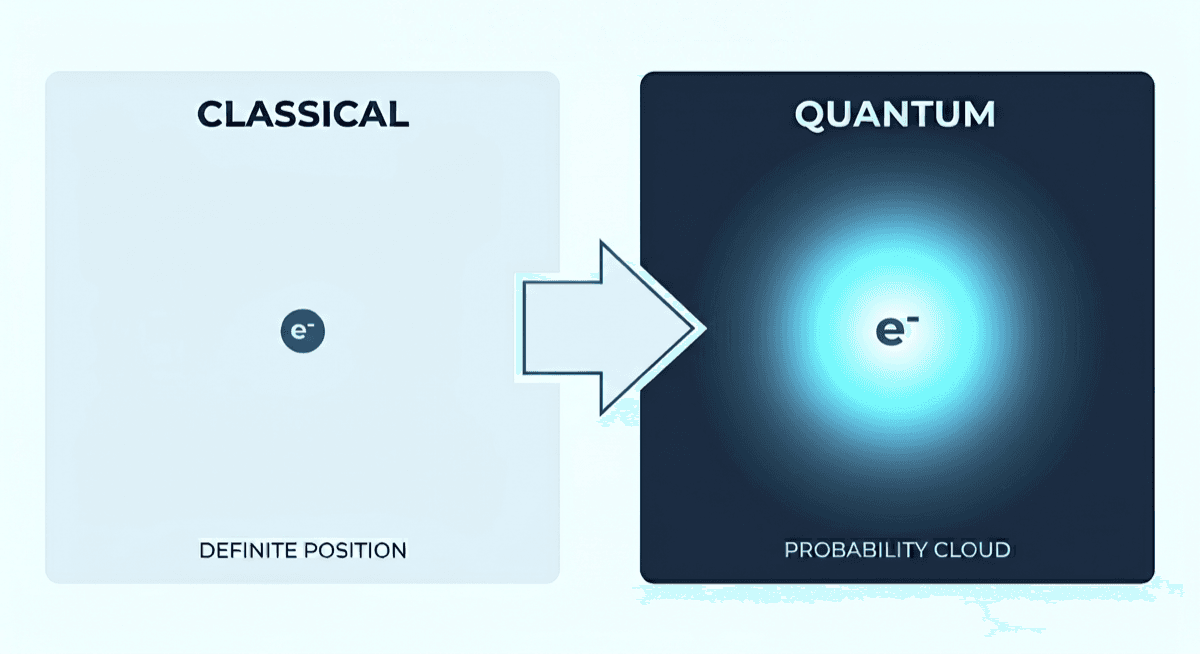
For example, our old model says that objects have well-defined properties, like position, and that we can measure that position at all times. However, we found that electrons don't act like that. They act like they are not in a set location at all. They can have far-reaching effects that prove they act more like a cloud than a particle. Scientists coined this a superposition, because it is a concept that goes beyond a “position.”
Across the next 50 years, scientists incorporated these observations into a brand new model of the universe. This model is actually more lenient, so it allows things we didn't think were possible. For example, it doesn't require electrons and photons to have a definite location, orientation, or velocity.
This new model turned out to be significantly more accurate than the old one.
Quantum has since taken over physics. At the largest physics conference in the world, the 2025 APS Global Physics Summit, over 75% of the exhibitors were related to quantum.
What quantum unlocks
Now, the fruits of 100 years of progress in quantum mechanics are coming to fruition. New quantum technologies are hitting the market that can break many assumptions we held about the world. Here are a few examples.
Better diagnostics
We assumed there was a limit to the smallest object we could see with normal light. Ernst Abbe coined this the diffraction limit. To see any smaller, we had to invent electron microscopes, and even these have their own limits.
New quantum microscopes have been invented which can break the diffraction limit. These microscopes use quantum properties of light to see extremely small objects, as small as viruses.
Faster computers
We assumed that there were certain problems that could never be solved with computers. Two such problems are:
- Cracking 2048-bit "RSA" passwords, which are used across the internet.
- Molecular property prediction, which would allow us to design whole new classes of medicines.
But now we know that both are possible. Obviously, cracking passwords is not a good outcome for the world. That's why we need to be very careful and informed about these technologies.
Secure communications
We assumed that, if you send information over the internet, there was no way to guarantee that nobody had secretly copied your information.
However, now we know that quantum enables the world's first un-eavesdroppable communications.
Three foundational concepts
Quantum has just three foundational concepts:
- Measurement
- Superposition
- Entanglement
In the following guides, you'll learn about each of these fundamental concepts in depth.