
Quantum entanglement is the strangest concept in the universe. It's the ability of two or more measurements to be dependent on each other, with no measurable connection between them, not even light.
But it's also not a magical, pseudoscientific force. Here's how entanglement really works, so you can judge it for yourself.
Definition
Entanglement is a dependence between two quantum measurements.
Note: nothing connects the two, not even light travels between them.
Try it for yourself
Below is a demonstration of two entangled qubits, shared between Alice and Bob. Try “measuring” their qubits to find a pattern!

No measurements yet.
No measurements yet.
Whichever basis you measure in, Alice and Bob always come out opposite.
What did you discover? Here are two takeaways:
1. If you measure in the same direction on both qubits, they always face opposite directions. How does Bob's qubit know what Alice got, and vice versa? That's the spooky thing. We can prove that real entangled qubits do know, even when separated by huge distances and measured instantaneously. This connection is faster than light, which shouldn't be possible.
2. Once entangled qubits are measured, they are no longer entangled. The qubits just deterministically give back the same answer again and again. Therefore, you can view entanglement as a consumable resource, once it's used up by measuring, it's gone.
How do we create entanglement in real life?
Short answer: bring two qubits close together.
Many kinds of qubits will naturally entangle when you bring them close. Take, for example, two electrons in the same orbital, like the two electrons in helium. These are naturally entangled.
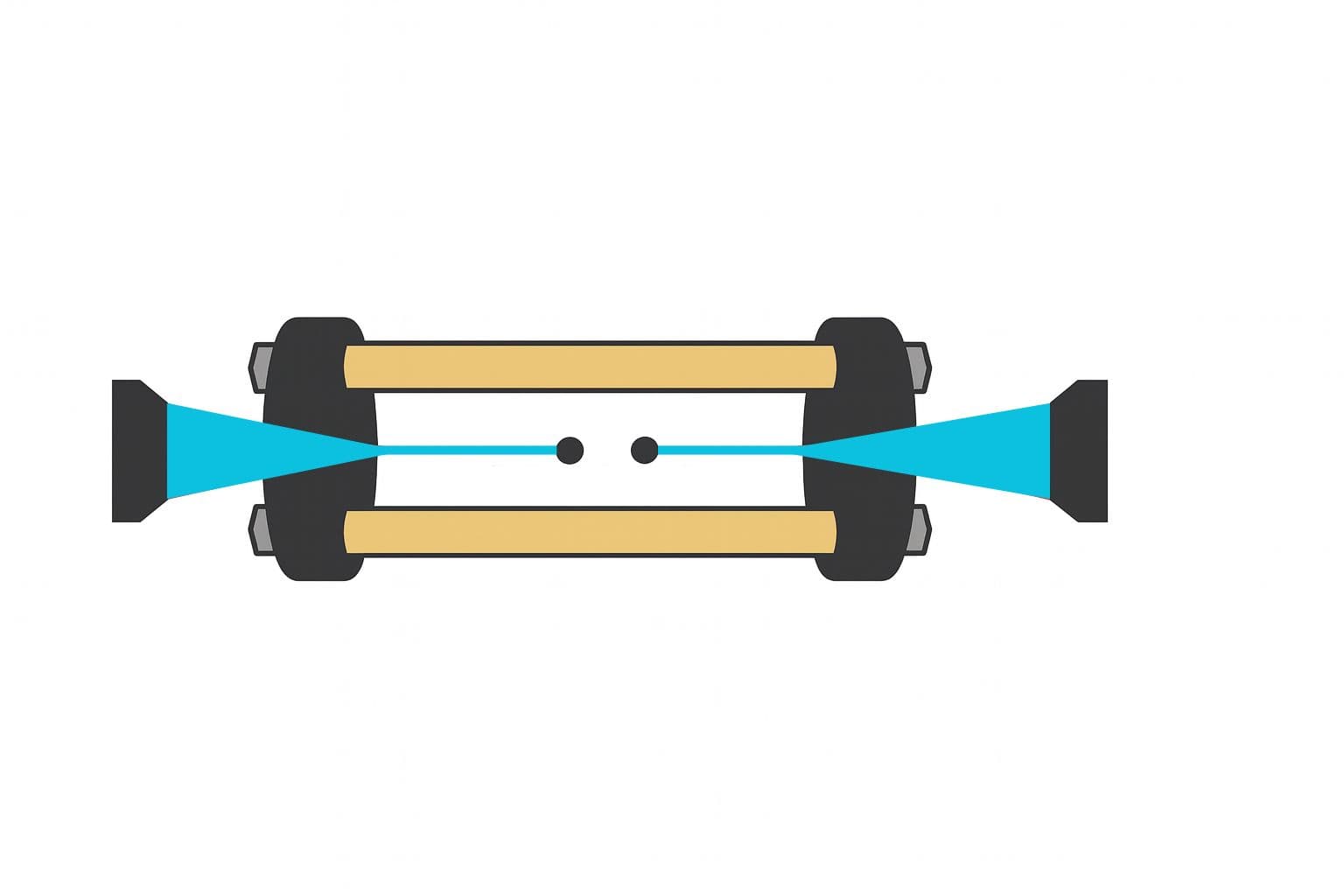
Another example: electron spins in a neutral-atom quantum computer. We entangle them by maneuvering the atoms that hold those electrons close together, then shooting them with a special laser. That triggers an interaction called the Rydberg interaction, which entangles the two.
Who chooses what “up” means?
Here's the key. There's no absolute “up” in the universe. Your up is different from Australia's up. So when we say the two atoms are always going to be facing opposite directions: opposite along what axis?
The answer is the strangest part of all of this. It turns out: your measurement apparatus decides what counts as up.
When you measure the spin of an atom, you can never just read off its direction. The spin could be pointing anywhere in space, but you can only ask one question: is it aligned with this axis, or against it? You pick the axis. The answer comes back “up” or “down.” That's a hard limit, no measurement we've ever built gets around it. According to quantum mechanics, it shouldn't even be possible to. (Although, who knows. Maybe you'll find a way.)
“But isn't it just predetermined?”
You might say: maybe the directions were just set when you brought the atoms together, not when you measured them. Maybe one atom was always going to be up, and the other was always going to be down. Maybe you're just discovering them when you measure, and there's nothing crazy happening.
That seems like the obvious conclusion. But it's wrong, and here's why.
Somehow, after you measure your qubit, the other qubit immediately snaps to the axis you measured along. If you measured up/down, the other snaps to up or down. Same if you measured side-to-side. Your intent is somehow transferred to the other qubit.
In fact, the experiment that proved this won the Nobel Prize in Physics in 2022. You can see a glimpse of it in the section below, but if you want to understand the experiment yourself, head to the next guide on the CHSH inequality.
That said: it's impossible to actually send information this way, because you don't get to decide which way the qubit goes (up or down). That's purely random.
Faster than light
You can measure this happening significantly faster than light could possibly travel between the two atoms.
In 2012, Anton Zeilinger's group ran exactly this kind of experiment between two of the Canary Islands - La Palma and Tenerife, 143 km (about 89 miles) apart. They entangled pairs of photons (which behave the same way as atomic spins for this purpose), sent them across the gap, and measured both ends.
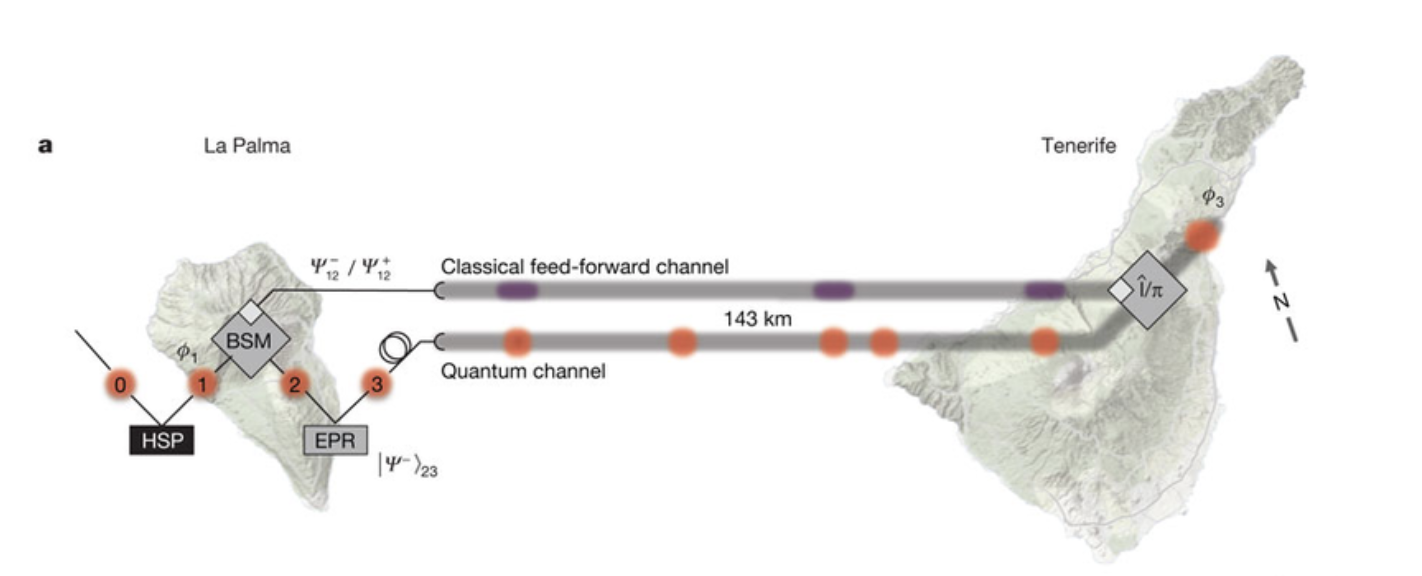
Their clocks were synchronized to about 3 nanoseconds. Light takes about 477,000 nanoseconds to make the trip. The correlations between the photons appeared faster than any light-speed signal between them could possibly explain.
Experiments of this kind won Zeilinger the 2022 Nobel Prize in Physics, alongside Alain Aspect and John Clauser, who'd run earlier versions in 1982 and 1972.
Can you use it to send messages?
So in the end, there are connections between things that are faster than light, and they don't care about distance. It's like a wormhole. Somehow, your decision about which direction to measure affects the partner.
But here's the last twist: you can't use this to send information. The connection is real, but it can't carry a signal, there's no way to control what the other person sees.
Why is the topic of the next guide. Stay tuned.